





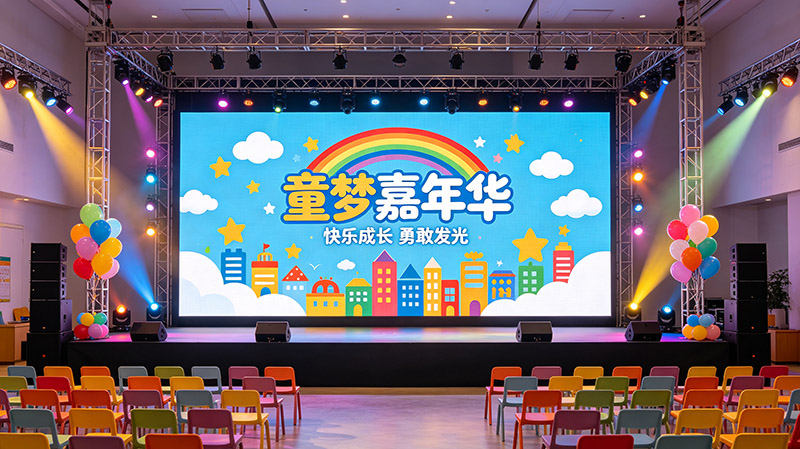


Outdoor Large-Scale Cultural & Sports Events LED Display Solution
Rental LED solution for large outdoor events and festivals — weather-ready, fast-lock cabi...


Rental LED solution for stages and performances — curve-lock cabinets with fast rig, front maintenan
Visualeader specializes in stage-performance LED display solutions. Serving concerts, galas, celebration events, XR virtual shooting and open-air performances, we deliver integrated solutions including display cabinets, control systems and flight cases, satisfying stringent requirements for repeated assembly-disassembly, tight construction schedules and zero-failure live-shows.
1.Lightweight cabinets for diverse stage-art styling Die-cast-aluminum standard cabinets adopt tool-free quick-lock design for fast assembly and disassembly. Equipped with anti-collision corner protectors, they are suitable for touring transportation. Supporting arc-shaped and L-shaped corner splicing, they can serve as main screens, side screens and floor screens. Modules and power supplies are replaceable from the front side. Matching flight-cases facilitate turnover for cross-city touring events.
2.Broadcast-grade picture quality optimized for shooting and complex stage lighting High refresh rate ≥3840Hz eliminates moiré patterns in recorded footage. Adjustable brightness and colour-temperature adapt to stage spotlight environments; wide viewing angles guarantee satisfactory viewing experience across the audience area. Support for XR and naked-eye-3D creative source-materials enables immersive stage-art effects.
3.Multi-layer signal redundancy for uninterrupted performances For key events, dual-players and dual-signal hot-backup are configured with automatic switch-over upon faults. Seamless multi-signal switching, split-window display and image roaming are supported to meet synchronous output requirements for live streaming, subtitles and special-effects.
4.Comprehensive product portfolio for both indoor and open-air deployment Product range covers indoor stage screens, semi-outdoor waterproof screens and high-load anti-slip stage floor tile screens, capable of resisting light rain and dust in open-air scenarios. Cabinets can be supplied separately or delivered as complete turn-key packages.
5.Pre-delivery factory testing to shorten on-site commissioning time Splicing, colour-calibration and signal testing are completed before shipment to eliminate hidden risks in advance. This reduces on-site rigging-and-debugging workload and lowers performance-failure risks.
6.Supporting stage-engineering services complying with strict safety codes Drawings for layout, hoisting and power distribution can be output, specifying hoisting points, counterweights and power-consumption requirements to avoid safety hazards during hoisting and power-supply operations and facilitate coordinated construction with lighting and audio-visual teams.
7.End-to-end technical services Services include solution design, drawing production, factory testing and technical briefings. On-site technical staff can be dispatched for large-scale performances. Itemized transparent quotations are provided. Products hold CE, FCC and RoHS certifications to satisfy bidding requirements and event-approval formalities.
|
|
A stage-use LED display is a modular direct-view video system assembled from standardized LED cabinets. It supports floor stacking, wall-mounting and high-altitude hoisting. It can be deployed as main-stage backdrops, side screens, lintel screens, floor tile screens, curved special-form screens and custom stage-art styled screens.
Different from traditional projectors, LED screens are self-illuminated, requiring no projection optical path and immune to ambient-light interference. Modular cabinets allow flexible adjustment of screen dimensions and styling according to venue footprint, playback source-materials, audience sight-lines, structural load-bearing and event schedules, suiting diverse performances, conferences and press-conference activities.
For concerts and music festivals, real-time camera feeds, dynamic visual source-materials, sponsor advertisements and stage-background rendering can be displayed. Modular screen bodies can be freely combined into main screens, side screens, LED floor tile screens, curved screens and hoisted screens, matching stage-art designs and audience sight-lines to realize diversified creative styling.
For corporate summits and product-launch events, screens play keynote speeches, product demonstrations, brand promotional videos and multi-camera live feeds. Screen configuration shall be comprehensively determined taking the nearest viewing distance, camera-shooting scheme, ambient lighting, source-material resolution, on-site erection conditions and floor load-bearing capacity into consideration.
For graduation ceremonies and academic conferences, screens display graduate portraits, attendee rosters, event videos, agenda schedules and guidance information. For outdoor ceremonies, cabinets with outdoor-grade protection ratings shall be selected. Brightness shall be adjusted according to sunlight incidence angles, viewing directions and operating duration to guarantee clear imagery.
In studios and virtual-production environments, large LED screens plus floor tile screens serve as virtual backdrops, enabling rapid scene-switching without physical set-building. For camera-shot projects, a complete matching system covering pixel pitch, refresh rate, scanning mode, colour-calibration, video processors, source-material frame-rate and camera shutter is required to minimize moiré patterns, scan-lines and screen flicker and secure high-quality live-stream output.
|
|
Brightness and pixel pitch shall be configured according to actual site conditions instead of blindly adopting generic parameters. Indoor-stage brightness shall not be excessively high; outdoor scenarios demand high anti-glare brightness. For close-range viewing and camera-shooting scenarios, fine-pitch products are preferred for delicate imagery. During selection, brightness, contrast ratio, grey-scale, colour-calibration and real-camera shooting results shall be verified.
Interactive content such as live streaming, animated footage and social-media wall posts shortens the distance between stage and audience. Dynamic special-effects and image overlay elevate on-site atmosphere, strengthening visual impact and emotional resonance.
Lightweight die-cast-aluminum cabinets feature precise positioning structures, quick-release latches and integrated power-and-signal interfaces to cut assembly-disassembly time. Front-service, rear-service or dual-sided-service modes can be selected according to stage depth, safety schemes and maintenance-access passages for space-constrained venues.
Power consumption is affected by screen area, brightness level, playback source-materials, cabinet craftsmanship and redundancy design. When purchasing or renting, obtain peak-power-consumption and average-power-consumption data to rationally configure power distribution, cables, heat-dissipation hardware and backup power supplies. Evaluate whether rental or purchase delivers better value considering show volumes, labour costs, warehousing-logistics, maintenance and equipment service life.
Modular cabinets support flat, curved, corner-shaped, trapezoidal, mesh-style, floor-tile and hoisted-mount forms. Prior to special-form customization, confirm allowable splicing angles, splicing-gap tolerances, fixing structures, source-material pixel-mapping and maintenance schemes to guarantee aesthetic styling, intact imagery and convenient subsequent servicing.
Rental-oriented screens are designed for repeated transportation, fast assembly-disassembly and frequent styling reconfiguration, suited for multi-stop touring events. Permanently-installed screens are built for long-term stationary deployment, prioritizing stable operation and maintenance and not intended for repeated disassembly-and-transport.
Comparison Item | Stage-Rental LED Display | Permanently-Installed LED Display |
Application Scenarios | Concerts, touring shows, temporary corporate events, short-term exhibitions | Permanent advertising, auditoriums, fixed venue installations with stationary screens |
Cabinet Structure | Lightweight die-cast-aluminum cabinets, tool-free quick-locks, integrated interfaces, optimized for assembly, disassembly and transportation | Steel / ordinary aluminum enclosures, heavy-weight, optimized for long-term stability, low assembly-disassembly efficiency |
Pixel-Pitch Selection Logic | Determined by nearest viewing distance and camera positions; consistent with permanent-installation logic | Determined by nearest viewing distance and camera positions; consistent with rental-screen logic |
Refresh Rate | ≥3840Hz preferred for live-shooting; full-system coordinated commissioning required | ≥3840Hz preferred for live-shooting; full-system coordinated commissioning required |
Special-Form Capability | Equipped with arc-locks, corner cabinets and floor-tile accessories; styling structures can be repeatedly disassembled and reused | Special-form realizable, yet structures and maintenance workflows are tailor-made for the fixed project and cannot be reused |
Note: Refresh rate is only a hardware parameter. Co-operation between processors, camera shutter and source-material frame-rate is required for complete moiré-pattern elimination.
|
|
Prices are jointly determined by pixel pitch, screen area, cabinet type, lamp-bead specifications, brightness, refresh rate, protection rating, video processor, erection structures, power-distribution systems, flight-cases, spare-parts, logistics, installation-commissioning and after-sales support. Price comparison must be performed against identical bill-of-materials to avoid low-ball quotations with downgraded configurations.
1.Pixel Pitch: Smaller pixel-pitch means higher pixel density per unit area, raising hardware and signal-processing costs.
2.Screen Dimensions: Larger area increases costs for cabinets, structures, power-distribution, cabling, packaging and labour.
3.Brightness & Shooting Compatibility: High-brightness lamp-beads, premium drivers, colour-calibration and live-broadcast-grade configurations push up costs.
4.Protection Rating: Outdoor-grade cabinets demand water-dust-proofing, anti-corrosion, heat-dissipation and waterproof connectors; higher protection ratings entail higher costs.
5.Cabinets & Accessories: Die-cast-aluminum cabinets, touring accessories, arc-locks, floor-tiles and custom steel-frames increase overall project cost.
6.Logistics & Services: Transportation, customs clearance, installation-commissioning, training, spare-parts, warranty and response time shall be itemized for costing.
1.Indoor Fine-Pitch Screens: High per-square-meter cost stemming from high pixel density, heavy receiving-card load, high-precision cabinet-splicing and complex colour-calibration workflows. Quotations shall specify pixel-pitch, lamp-bead specifications, scanning mode, brightness, grey-scale, refresh-rate, processor and spare-part proportion. Do not blindly pursue the minimal pixel-pitch. Make trade-offs considering shooting distance, moiré-pattern risks, native resolution, processor performance, maintenance and total-project-cost.
2.Outdoor Waterproof Screens: Additional costs arise from protective cabinets, waterproof connectors, high-brightness lamp-beads, heat-dissipation hardware and outdoor steel-frames. Confirm IP rating, operating-temperature range, wind-resistance of structures and factory-set brightness. Lump-sum quotations shall break down costs for cabinets, processing equipment, trusses, power-distribution, cabling, flight-cases, spare-parts, logistics, installation-commissioning, training and after-sales to prevent omitted-item risks.
3.Cost Difference Between Purchase and Rental Modes: Purchase delivers better value for venues with high-frequency usage. For infrequent temporary events, rental is preferred to avoid costs for warehousing, maintenance, transportation and equipment-obsolescence. Evaluate cost per single-show instead of merely comparing per-square-meter unit prices.
1.Venue Type: Distinguish indoor / outdoor scenarios, which determine brightness and protection-rating requirements.
2.Audience Scale & Viewing Distances: Confirm maximum and minimum viewing distances to define screen dimensions and pixel-pitch.
3.Source-Material Types: Live-feed, pre-recorded video or graphic content, for matching resolution and signal-processing capacity.
1.Up-front Investment: Balance budget, picture quality and functions to avoid under-specification or performance overkill.
2.Post-Deployment Costs: Energy consumption, repair work and spare-parts expenditure.
3.Rental vs Purchase: Select rental for infrequent events; opt for purchase for venues with long-term high-frequency usage.
1.P1.95-P2.6: Indoor close-range scenarios, small-scale conferences and theatres.
2.P2.9-P3.91: Medium-size venues for medium-to-long viewing distances, delivering favourable overall cost-performance.
3.P4.81 and above: Large-scale outdoor events for long-distance audiences.
Quick reference: Minimum viewing distance (meters) ≈ pixel-pitch (millimetres).
1.Indoor: 800-1200 cd/㎡ for soft imagery.
2.Outdoor: ≥5000 cd/㎡ to counteract sunlight.
3.High contrast ratio enhances layering of stage-art footage.
1.Cabinet Material: Die-cast-aluminum features high mechanical strength and favourable heat-dissipation, suited for repeated assembly-disassembly.
2.Outdoor-Grade Protection: IP65 or above.
3.Maintenance: Support front- / rear-side servicing. Individually replaceable modules reduce fault-downtime.
1.Video processors shall support diverse signal sources and meet resolution-output requirements.
2.Multi-screen splicing guarantees synchronized imagery without stutter or offset.
3.Intuitive operation-interface facilitates fast on-site commissioning.
Provide venue drawings, viewing distances, camera-positions, source-material specifications, erection schemes, power-distribution requirements, schedules and maintenance-demands to obtain technical proposals. Proposals shall be reviewed by event-execution, structural-engineering and electrical-engineering teams.
Configuration lists, drawings, delivery conditions, production-and-testing cycles, acceptance criteria, warranty clauses, spare-parts allocation, installation responsibilities, training arrangements and after-sales-response mechanisms shall all be documented within quotations and formal contracts.
|
|
Key parameters: viewing distance, pixel pitch, resolution.
Step 1: Define core viewing distances Record viewing positions for nearest-seat audiences, regular-audience zones, farthest-seat audiences and all camera-shooting positions.
Reference: Optimal viewing distance (m) ≈ 2 × pixel-pitch (mm). Example: P4 yields optimal viewing distance of approx. 8 m. For reference only; real-world validation with source-materials and cameras is required.
Step 2: Preliminary pixel-pitch screening Fine-pitch delivers superior imagery yet increases power-consumption, cost and computing load. Larger pixel-pitch may be adopted for long-distance viewing. Select 2-3 candidate pixel-pitch values and compute native resolution for each option for comparison.
Step 3: Native-Resolution Calculation Pixel Width = Screen Width (m) × 1000 ÷ Pixel-Pitch (mm) Pixel Height = Screen Height (m) × 1000 ÷ Pixel-Pitch (mm)
Note: Screen native resolution need not equal 1080P / 4K. Produce source-materials matching the screen’s actual pixel dimensions to avoid scaling-induced distortion.
Step 4: Physical-Dimension Conversion Screen Width (m) = Pixel Width × Pixel-Pitch (mm) ÷ 1000 Screen Height (m) = Pixel Height × Pixel-Pitch (mm) ÷ 1000
Round results to match standard cabinet dimensions. Validate stage footprint, load-bearing capacity, maintenance-access passages and viewing-angles.
Step 5: Image Aspect-Ratio and Source-Materials 16:9 standard: Height = Width × 9 ÷ 16. Special-form screens are not constrained to 16:9. For special-form projects, provide pixel-mapping diagrams, safe-zone specifications and cropping schemes prior to source-material production.
1.Small-Scale Indoor Venues: Prioritize fine-pitch products. Make comprehensive evaluation considering nearest viewing-distance, camera-positions, screen dimensions, source-materials, processor performance, heat-dissipation, power-consumption and budget; do not focus solely on resolution figures.
2.Medium-Scale Venues: Compare multiple pixel-pitch options taking audience distribution and camera-positions into account. Medium pixel-pitch strikes a balance between picture-quality, cabinet quantity, overall resolution, processing load and cost.
3.Large-Scale Outdoor Venues: Prioritize physical screen dimensions, daytime visibility, protection-rating, structural integrity and camera-testing. Calculate native resolution according to actual screen size instead of over-emphasizing 4K labelling.
No universal pixel-pitch exists. The optimal configuration satisfies viewing-experience, shooting-requirements, structural-and-power-supply constraints and budget limits.
Q1: What is the approximate power-consumption of stage-use LED screens? A: Power-consumption depends on pixel-pitch, brightness, displayed imagery and screen area. Peak-power-consumption and average-power-consumption per square-meter can be provided for power-budget calculation according to event duration.
Q2: What service-life can stage-use LED displays achieve? A: Formal-grade products deliver long service-life under standardized operation, reasonable brightness setting and regular maintenance. Rental-grade screens support cyclic deployment for multiple shows; permanently-installed screens are suited for year-round continuous-operation.
Q3: What are recommended waterproof-rating and brightness standards for outdoor-stage screens? A: IP65 protection-rating and brightness ≥5000 cd/㎡ are recommended for outdoor scenarios against sunlight, wind and rain. Note: IP65 generally applies to the front-side of modules; rear-sides and connectors still require rain-shielding measures.
Q4: Are 4K-resolution stage-screens mandatory? A: 4K is not compulsory. Source-materials produced matching the screen’s native resolution yield better results than forcibly scaled-up 4K footage.
Q5: For stage-live-feed signal transmission, which is preferable: SDI or HDMI? A: SDI features superior anti-interference performance and is preferred for long-distance transmission, professional live-broadcast and multi-device interconnection. HDMI suffices for short-range simple-use scenarios.
Rental LED solution for large outdoor events and festivals — weather-ready, fast-lock cabi...

Rental LED solution for exhibitions and trade shows — fast-rig, seamless booth screens tha...
Send the pitch, size and site conditions — you’ll get a spec and a price, not a brochure.

