







Stage & Performance Rental LED Display Solution
Rental LED solution for stages and performances — curve-lock cabinets with fast rig, front...


LED solution for command centers and control rooms — seamless fine-pitch walls with low heat, 24/7 u
1.Comprehensive Full-Range Multi-Grade Product Portfolio
Visualeader delivers complete fine-pitch products with SMD / GOB / COB packaging, covering commonly-used pixel pitches for command centers: P0.9, P1.25, P1.53, P1.86 and P2.0. Three complete configuration packages (Basic, Mid-Tier and High-End) are available to suit public-security, emergency-response, park and factory dispatch projects with varying budget limits.
2.Hardware Reliability Design for 7×24-Hour On-Duty Operation
Die-cast-aluminum magnetic-attached front-service cabinets support multiple redundancy schemes: N+1 and 1+1 dual-backup power supplies, receiving-card loop backup and 1+1 dual-backup sending cards. Industrial-grade receiving cards collect and report full-status alarms for temperature and voltage. For priority projects, single-point hardware failures will not cause full-screen blackouts, satisfying non-stop operational requirements for command-and-dispatch workflows.
3.Superior Display Quality Optimized for Monitoring & Dispatch Operations
Professional indoor brightness of 300-450 cd/㎡ with automatic dimming driven by ambient-light sensors. ≥16-bit high grayscale preserves fine details for low-light night-time monitoring footage. A refresh rate ≥3840 Hz eliminates moiré patterns and scan lines during camera recording. Point-by-point factory color calibration guarantees uniform color performance across the whole screen without color blocks. GOB / COB variants offer dust-proof, moisture-proof and impact-resistant properties for long-term operation in command halls exposed to indoor dust and humidity.
4.End-to-End System Delivery Capability — Beyond Bare Display Hardware
In addition to LED display panels, we supply supporting video processors, decoding servers, command-and-dispatch management software, power-distribution hardware and structural recommendations. Deliverables include cabinet layout drawings, power-consumption calculations, cable lists and contingency-plan templates. We perform preliminary solution design and integrate legacy monitoring and video-conference systems to reuse existing customer assets.
5.Robust Production & Quality-Control System
In-house standardized production workshops with full-process quality inspection. Products hold certifications including CCC, CE, RoHS, ISO9001 and ISO14001. Aging tests are completed before shipment to reduce on-site failure probability.
6.Professional Project Implementation & Operation-Maintenance Services
Services include detailed project design, on-site installation and commissioning, and operator training. Spare-part kits are allocated according to project priority levels, and complete operation-maintenance logs are maintained. Priority command projects receive 7×24-hour technical support with dual-tier remote-plus-on-site fault response to guarantee stable command-and-dispatch operations.
7.Network-Security & Software Adaptation
Dispatch-management software supports hierarchical permission controls and comprehensive operation-audit logs. Network-isolation schemes are tailored for each project to comply with government intranet security specifications and meet information-security-audit requirements for command centers.
|
|
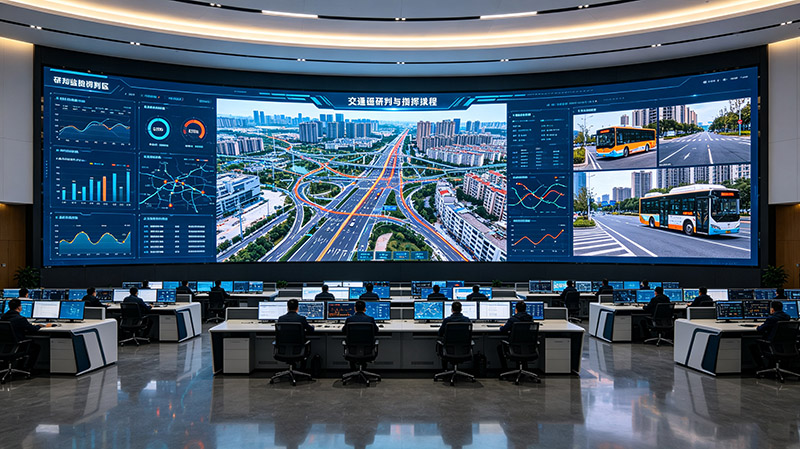
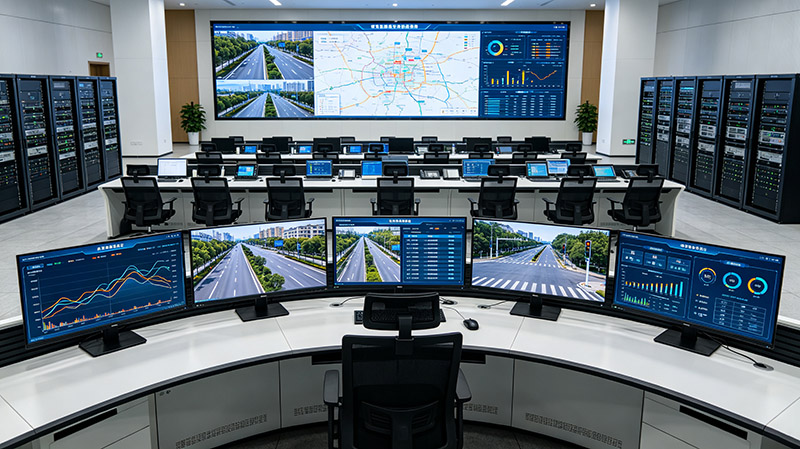
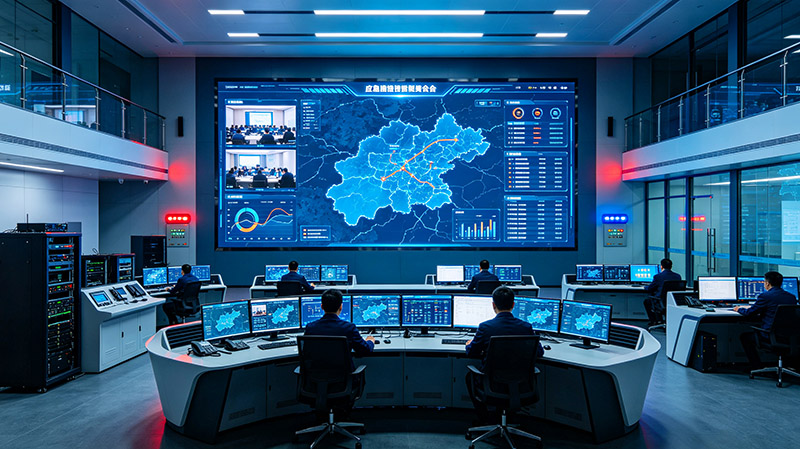
Command-dispatch-monitoring LED large-screens are widely deployed in public-security emergency-command centers, urban-operation management centers, traffic-control centers, park-security dispatch hubs and industrial-plant production-control rooms.
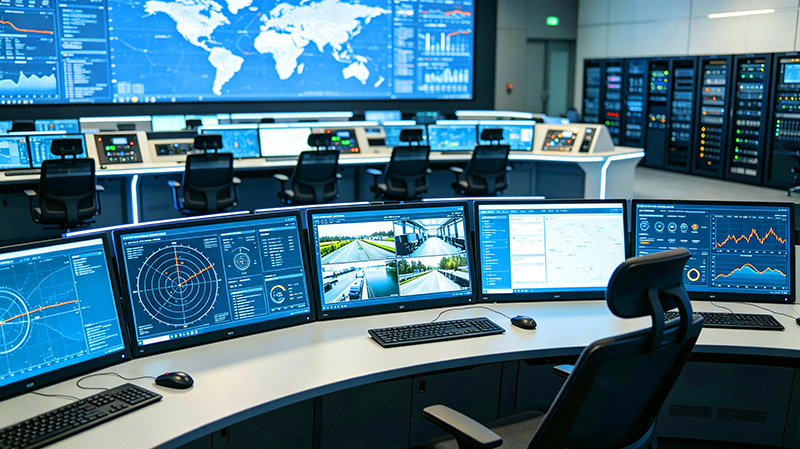
Indoor fine-pitch LED displays serve as the core visualization carrier. Multiple heterogeneous signal sources are connected: network IPC surveillance cameras, NVR playback feeds, GIS geographic-information maps, business-workstation desktops, alarm push signals and video-conference terminals. The system enables multi-source windowing, roaming, overlay and zoned synchronous display.
Built for 7×24-hour non-stop duty, the platform delivers situational awareness, real-time monitoring, alarm linkage, multi-party remote conferences, event analysis and instruction issuance, forming an integrated visual decision-support tool for dispatch managers.
Distinct from ordinary meeting-room large-screens, core requirements include stable long-duration continuous operation, excellent detail reproduction for low-light monitoring footage, dust-and-moisture resistance, degraded-operation upon faults, redundant key hardware and moiré-free camera recording.
1.Multi-channel surveillance videos, GIS maps, business reports and alarm messages support windowing, roaming, overlay and split-screen simultaneous display.
2.Support 7×24-hour continuous duty; single-point hardware faults must not trigger full-screen blackouts.
3.Preserve rich tonal gradations for dark night-time monitoring scenes; flicker-free and moiré-free output for conference recording and camera capture.
4.One-touch recall of contingency plans; automatic pop-up alarms linked to corresponding surveillance camera feeds.
5.Hierarchical account permission management; retention of full operation logs for security audits.
6.Three configuration tiers (Basic, Mid-Tier, High-End) for varying project budgets, with support for re-using existing business equipment.
Pixel pitch is determined by the closest viewing distance from operator workstations, physical screen dimensions and business requirements for text and map rendering. Smaller pixel pitches do not always equal better performance, as they raise costs and power consumption.
Pixel Pitch | Minimum Viewing Distance | Application Scenarios |
P0.9 | ≥1.5 m | High-end command halls with close-range operator seats and sufficient budget |
P1.25 | ≥2.0 m | Mainstream high-end command centers, widely used for public-security and emergency halls |
P1.53 | ≥2.5-3.0 m | Preferred choice for most command projects, balancing image quality and cost |
P1.86 | ≥3.0-3.5 m | Mid-tier projects for spacious halls with constrained budgets |
P2.0 | ≥4.0 m | Basic economical option for simple dispatch rooms in factories and industrial parks |
Business Note: Command centers extensively render GIS maps and small surveillance text. Pixel pitches larger than P2.0 are generally not recommended.
1.SMD Surface-Mount Packaging: Conventionally soldered discrete LED chips on PCBs. Mature technology with low module-repair costs. Exposed chips are vulnerable to dust and humidity. Suitable for clean-environment simple dispatch rooms with limited budgets.
2.GOB (Glue On Board): A transparent protective glue layer covers SMD chips. It delivers dust-proof, moisture-proof and impact-resistant performance with color performance comparable to SMD. Full-module replacement is required upon damage. Preferred for standard command-and-dispatch projects for 7×24-hour continuous operation in dusty and humid indoor environments.
3.COB (Chip On Board): LED chips are directly packaged and fully potted onto PCB substrates. It achieves best-in-class dust-proofing, moisture-proofing and heat dissipation, with superior black-level consistency for night-time monitoring. Higher procurement cost; modules must be replaced as whole units. Suitable for high-priority command halls for public-security and emergency-response applications.
1.Brightness: 300-450 cd/㎡ for indoor command halls; outdoor high-brightness modules are forbidden. Ambient-light-sensor-driven automatic brightness adjustment prevents eye fatigue during prolonged viewing.
2.Grayscale ≥16-bit: Preserves shadow detail for low-light night-time monitoring footage. COB and GOB outperform standard SMD for dark-scene rendering.
3.Refresh Rate ≥3840 Hz: Eliminates moiré patterns and scan lines in camera recordings to satisfy conference recording and live-archiving requirements.
Most command halls have limited rear-side service clearance. Prioritize die-cast-aluminum front-service cabinets with magnetic-attached modules. Modules, power supplies and receiving cards can be replaced from the front without full-screen disassembly. Optimized internal air channels slow component aging under 7×24-hour operation.
Includes N+1 / 1+1 power-supply redundancy, receiving-card loop signal backup and 1+1 dual-backup sending cards. Upon single-point hardware failure, the screen avoids full blackout; background alarms are triggered while business workflows continue uninterrupted for emergency operations.
|
|
Comparison Item | Fine-Pitch LED Display | DLP Rear-Projection Video Wall | LCD Video Wall |
Splicing Seam Performance | True seamless splicing; intact unbroken lines for maps and surveillance feeds | Minimal but existent unit-to-unit gaps | Physical black splicing seams; fine lines and text may be cut or obscured |
Brightness & Adjustment | 300-450 cd/㎡ brightness, auto-dimming support, high refresh rate, moiré-free shooting | Relatively low brightness; lamp degradation and wear occur | Fixed brightness; narrow-bezel panels still retain seams |
Maintenance Approach | Front-service; replace modules from front; no large rear-side clearance required | Requires substantial rear-side maintenance space; lamp replacement cycles | Requires rear-side maintenance clearance |
Service Life | Long-lived LED chips; only faulty individual modules are replaced | Lamps require periodic replacement; high consumable costs | Faults require replacement of complete display panels |
Image Performance | Excellent dark-scene rendering, ideal for surveillance and GIS-map display | Soft color reproduction; deep cabinet depth | Vibrant colors but map integrity compromised by seams |
Overall Thickness | Slim profile; suitable for recessed or wall-mounted installation | Deep cabinet footprint, occupies significant rear depth | Moderate cabinet thickness |
Disadvantages | Higher procurement cost for equivalent resolution; power-and-signal redundancy design is mandatory | Bulky equipment; high long-term lamp-maintenance expense | Cannot achieve true seamless visuals; fine lines break across seams |
1.Fine-Pitch LED: The mainstream current solution for public-security, emergency-response and urban-operation command centers. Ideal for scenarios requiring complete GIS-map rendering, multi-source simultaneous surveillance display, seamless visuals and limited rear-side installation space.
2.DLP Rear-Projection: Used in legacy older-generation command centers. New projects are gradually migrating away due to lamp-consumable overhead and bulky physical dimensions.
3.LCD Video Wall: Fits simple monitoring rooms in industrial parks and enterprises where seamless visuals are not a hard requirement and budgets are constrained.
The complete system forms a closed-loop end-to-end workflow covering signal ingestion, processing, display, control and operator interaction across five layers:
1.Signal-Source Layer: Network IPC surveillance cameras, NVR storage devices, GIS business servers, workstations, video-conference terminals, alarm-push servers and local notebook-PC signal inputs.
2.Ingestion-Processing Layer: IP decoding servers and video splicing processors for video-stream decoding and signal-format conversion.
3.Display-Output Layer: Fine-pitch LED display panel plus supporting audio-amplification systems.
4.Dispatch-Control Layer: LED sending / receiving cards, command-and-dispatch management-platform software, industrial control hosts and dedicated intranet switches.
5.Operator-Terminal Layer: Dispatch consoles, touch-control consoles, management PCs and controlled tablet clients.
Various business signal sources → Decoding / Video Processor → LED Control System → LED Large-Screen. Operators issue commands via client terminals to perform window-layout switching, contingency-plan recall and alarm-pop-up linkage.
|
|
(Focus: pixel-pitch selection; SMD / GOB / COB comparison; brightness-grayscale indicators; cabinet mechanical structure)
Primary reference is the closest viewing distance for dispatch operators, combined with screen dimensions, business-content requirements and project budget.
1.High-Priority Premium Command Halls: P0.9-P1.25, operator-to-screen viewing distance ≥2 m
2.Most Government-and-Park Command Projects: P1.53, viewing distance ≥2.5 m
3.Budget-Constrained Spacious Halls: P1.86
4.Simple Factory Dispatch Rooms: P2.0
Packaging Type | Core Characteristics | Command-Scenario Application Guidance |
SMD Surface-Mount | Moderate cost, convenient repair; exposed chips vulnerable to dust and moisture | Simple dispatch rooms with clean environments and constrained budgets |
GOB Glue-On-Board | SMD base plus transparent surface glue layer; dust-proof, moisture-proof and impact-resistant; full-module replacement upon damage | Recommended for most command projects, balancing protection and cost |
COB Chip-On-Board | Superior dust-proofing, moisture-proofing and heat dissipation; best-in-class night-time surveillance visuals; high cost; modules must be replaced as complete units | High-priority 7×24-hour non-stop command halls for public-security and emergency-response with sufficient budgets |
1.Brightness: 300-450 cd/㎡ with ambient-light-sensor-enabled automatic dimming.
2.Grayscale ≥16-bit: Preserves shadow detail for night-time surveillance footage.
3.Refresh Rate ≥3840 Hz: Delivers moiré- and scan-line-free camera recording.
1.Die-cast-aluminum metal cabinets for high flatness and minimal splicing gaps.
2.Magnetic-attached front-service modules; modules, power supplies and receiving cards are detachable from front without large rear-side service space.
3.Optimized internal air-channel design slows component aging under sustained 7×24-hour runtime.
Command-and-dispatch environments run 7×24-hour on-duty operations. Protection against full-screen blackouts from single-point faults is organized into three reliability tiers.
1.Basic Single-Power-Supply Configuration (Basic Tier): One power supply per cabinet. Cabinet-level blackout occurs upon power-supply failure. Only permitted for simple factory dispatch rooms; not recommended for government, public-security or emergency-response projects.
2.N+1 Redundant Power Supplies (Mid-Tier Mainstream): Multiple power supplies mutually back each other. Upon single-unit failure, remaining power supplies share the load; the screen continues normal operation with background fault alerts and zero business interruption. Recommended for ordinary government and park-command projects.
3.1+1 Dual-Backup Power Supplies (High-End Priority Tier): Two fully independent power paths operate simultaneously for module zones. If one path fails completely, the second takes over with zero power-interruption risk. Deployed for 7×24-hour non-stop mission-critical public-security and emergency-response command halls.
1.Basic Single-Network-Cable Scheme: Signal transmitted over one cable; cable failure triggers blackout in corresponding zones. For simple dispatch-room usage only.
2.Receiving-Card Loop Backup (Mid-Tier Mainstream): Receiving-cards are wired in a ring topology. If one cable is broken, signals automatically reroute via the opposite side of the loop, maintaining continuous display with background fault alerts.
3.1+1 Dual-Backup Sending Cards (High-End Tier): Two sending-card units output synchronized content. Upon primary-sending-card failure, instant switch-over to the backup unit preserves full-screen output. Deployed for highest-security-grade command centers.
Command projects require industrial-grade receiving-cards capable of real-time collection of cabinet temperature and voltage readings, triggering software pop-up alarms for abnormal power or over-temperature conditions. Ordinary commercial receiving-cards lack status-monitoring functions and are unsuitable for command-dispatch scenarios.
Configuration Guidance
1.Simple factory dispatch rooms: Single power supply + single network cable
2.Most government and park-command deployments: N+1 redundant power supplies + receiving-card loop backup
3.Public-security & emergency-priority halls: 1+1 dual-backup power supplies + 1+1 sending-card backup + receiving-card loop backup
|
|
Configuration Item | Basic-Economical Tier (Simple Factory Dispatch Rooms) | Mid-Tier Mainstream (Parks, Urban Operations, General Emergency-Command; Most Widely Used) | High-End Priority Tier (7×24-Hour Non-Stop Core Public-Security & Emergency-Command Halls) |
Pixel Pitch | P1.8-P2.0 | P1.53 (Preferred) / P1.86 | P0.9-P1.25 |
Chip Packaging | Standard SMD Surface-Mount | GOB Glue-Protected (Recommended) | COB (Preferred) or premium-grade GOB |
Service Cabinet | Die-cast-aluminum front-service cabinet | Die-cast-aluminum front-service cabinet | High-flatness die-cast-aluminum front-service cabinet |
Power-Supply Setup | Ordinary single power supply | N+1 redundant power supplies | 1+1 dual-backup power supplies |
Signal Link | Single network cable | Receiving-card loop backup | 1+1 sending-card backup + receiving-card loop backup |
Receiving-Card | Ordinary commercial receiving-card | Industrial-grade receiving-card with temperature & voltage alarms | High-reliability industrial-grade receiving-card with full-parameter status feedback |
Brightness | 300-400 cd/㎡ | 300-400 cd/㎡ with ambient-light-sensor automatic dimming | 300-400 cd/㎡ with ambient-light-sensor automatic dimming |
Refresh Rate | ≥1920 Hz | ≥3840 Hz | ≥3840 Hz |
Grayscale | 14-16 bit | 16 bit | 16-bit high-dynamic-range grayscale |
Video Processor | Ordinary single-power-supply processor | Dual-power-supply processor supporting contingency plans and IP-stream decoding input | 1+1 hot-standby redundant processor unit |
Decoding Server | Single unit | Single unit | Dual-unit hot-standby decoding servers |
Control Host | Commercial-grade host | 7×24-hour industrial-grade IPC | Dual-power-supply industrial-grade IPC |
UPS Power Supply | Optional | UPS equipped | Standard-fit UPS uninterruptible power supply |
Spare-Parts Allocation | 2 % spare modules, power supplies and receiving-cards | 3-5 % spare modules, power supplies and receiving-cards | 5-8 % spare modules, power supplies and receiving-cards |
Applicable Scenarios | Simple enterprise-factory dispatch, brief out-of-service windows permitted | Government parks, urban-operation hubs and general emergency-command halls; balances reliability and cost | Mission-critical public-security and emergency-response command centers; zero-tolerance for service interruption; sufficient budget |
Procurement Reminder: When comparing quotations, do not evaluate only pixel pitch and per-square-meter unit price. Power-supply architecture, packaging technology, signal-backup schemes and spare-part ratios must be specified within technical specifications to prevent low-cost proposals from omitting redundancy and protective features.
1.Network-Isolation Principle: Establish an independent dedicated control intranet for the LED large-screen control system; direct internet access is prohibited. Business-monitoring networks and screen-control networks exchange data logically via firewalls / network-security gateways to block direct external-network access to screen-control ports.
2.Deploy industrial-grade gigabit switches exclusively for large-screen control-signal transmission.
3.Command-and-Dispatch-Management-Software Functions - Contingency-Scenario Management: One-touch switching of complete window-layout presets for routine on-duty workflows, emergency-incident response and multi-party conferences. - Window Operations: Window creation / closing, moving, scaling, z-order priority and cross-screen roaming. - Alarm Linkage: Connect to business-alarm interfaces; automatic pop-up windows and recall of associated surveillance-camera feeds upon alarm triggers. - Equipment-Status Monitoring: Read cabinet temperature, voltage, power-supply and receiving-card operating states with fault pop-up alarms. - Hierarchical Account Permissions: Role-based access separation for administrators, dispatch operators and observers. - Comprehensive Operation Logs: Log all signal-switching and plan-recall events; logs support export for audit purposes. - Multi-Terminal Control: Operate from dispatch consoles, touch-control consoles and controlled tablet clients.
|
|
Wall-mount and rack-recessed installation are supported. Front-service cabinets enable front-side maintenance. Ventilation clearance shall be reserved behind the screen. Decorative trim frames are provided.
1.Deploy independent power-distribution cabinets with lightning-surge protection.
2.Priority-level projects are equipped with UPS uninterruptible power supplies to sustain short-term emergency operation for large-screens, processors and decoding devices during mains-power loss.
3.Multi-loop power supply: Separate independent power loops for display panels, processors and servers to avoid mutual interference.
1.LED cabinets feature built-in air channels. The rear of the screen shall not be fully enclosed; ventilation gaps must be reserved.
2.Equipment racks in machine rooms are fitted with constant-temperature air-conditioning to stabilize processor and decoding-server operation and mitigate component aging caused by high temperatures.
Unified protective earthing for the entire system with earthing resistance ≤4 Ω to eliminate static-electric interference and prevent horizontal-line artifacts in surveillance footage.
1.Equipment-Status Monitoring: Industrial receiving-cards collect real-time power-supply, cabinet-temperature and voltage metrics. Abnormal conditions trigger pop-up alarms and optional email notifications for maintenance staff.
2.Spare-Parts Management: Spare modules, power supplies and receiving-cards allocated per project tier: 2 % for basic tier; 3-5 % for mid-tier; 5-8 % for high-priority projects.
3.Periodic Inspection Routine: Regular dust removal; inspection of screen brightness and color uniformity; verification of power-supply and temperature operating states.
4.Operator Training: System-operation training for dispatch staff; delivery of complete operation and maintenance manuals.
5.After-Sales Support: Standard 3-year overall hardware warranty; extended-warranty terms negotiable for priority command projects. 7×24-hour technical support including remote diagnostics and on-site fault-response services.
6.Fault-Handling Principle: On-site activities are limited to spare-part replacement. Faulty hardware shall not be disassembled or repaired during active duty cycles to preserve continuous business operation.
Rental LED solution for stages and performances — curve-lock cabinets with fast rig, front...

Rental LED solution for large outdoor events and festivals — weather-ready, fast-lock cabi...

Rental LED solution for exhibitions and trade shows — fast-rig, seamless booth screens tha...
Send the pitch, size and site conditions — you’ll get a spec and a price, not a brochure.

