








Stage & Performance Rental LED Display Solution
Rental LED solution for stages and performances — curve-lock cabinets with fast rig, front...


`Naked-eye 3D LED display solution — glasses-free 3D screens on curved corners that stop traffic, wi
Naked-Eye 3D LED Solution
Core Exclusive Advantages of Visualeader 3D-LED Displays
Visualeader is deeply-rooted in the outdoor naked-eye 3D-LED sector. Drawing on self-developed standardized cabinets and rich real-world project delivery experience, we serve commercial districts, landmark buildings, transportation hubs and other projects, delivering highly-adaptable, stable complete solutions for large-format 3D screens.
1.Professional naked-eye 3D visuals optimized for social-media dissemination
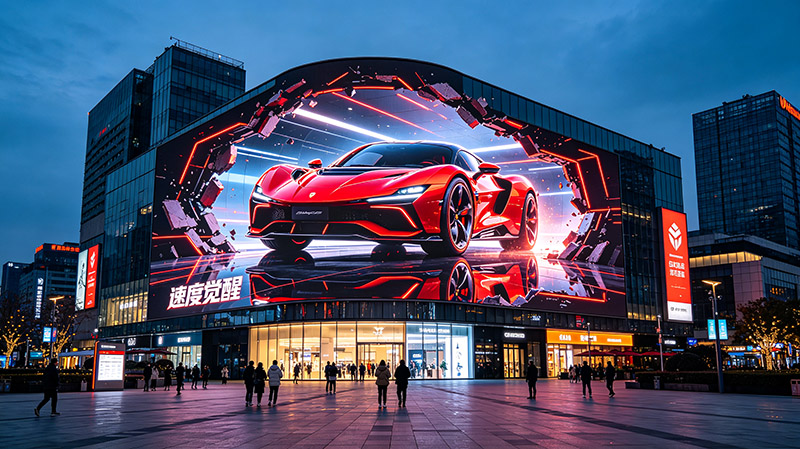
Distortion-perspective technology generates "popping-out-of-screen" stereoscopic effects without auxiliary equipment. Cabinet calibration is performed for primary viewing positions while preserving readability from alternative angles. A refresh-rate ≥3840 Hz eliminates moiré patterns in camera footage, well-suited for secondary short-video sharing. Overall brightness exceeds 5000 nits for sharp imagery under strong daylight, day and night.
2.High outdoor reliability for long-term energy-saving operation
M-series, MA-series, ME-series, AF-series and AT-series outdoor cabinets deliver full IP65 protection against rainwater, dust and temperature fluctuations and support 7×24-hour continuous operation. Intelligent voltage-regulating power supplies dynamically adjust power draw according to image load to cut electricity costs. Built-in fault-early-warning functions collect real-time status data for power supplies and modules and trigger advance alerts to minimize downtime caused by failures.
3.Modular design for multi-scenario compatibility
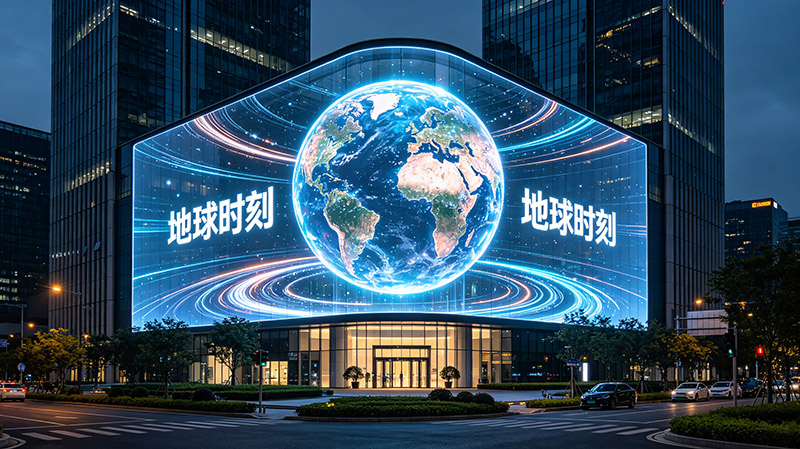
Standardized cabinets can be assembled into flat, right-angle corner and curved special-form screens, adapting to complex buildings such as building corners, curtain-walls and transportation hubs. A single hardware set enables one-click switching between creative 3D content and conventional 2D advertisements and information, maximizing equipment utilization for regular commercial operation.
4.Intelligent management and control for low-cost, simple operation & maintenance
Intelligent playback-control platforms support remote program updates, scheduled playback and multi-screen cluster-management and can interface with external data feeds for weather, traffic and more. Offline resume-play prevents advertisement interruptions upon network loss. Modules and power supplies can be replaced individually without full-screen disassembly to reduce later-stage maintenance costs.
5.Localized end-to-end project delivery
Pre-project on-site surveys comprehensively assess building load-bearing capacity, wind-load, advertising-approval formalities and maintenance-access conditions to deliver integrated hardware-plus-steel-structure solutions. Itemized transparent quotations contain no hidden charges. Full-range technical services cover configuration-selection, screen modelling, 3D-content adaptation, installation and commissioning to guarantee real-world 3D display performance matches expectations.
|
|
I. Overview of 3D-LED Displays
3D-LED displays belong to the large-format LED-screen category. They build image depth primarily through naked-eye distortion-perspective content and stereoscopic-visual techniques. Outdoor projects frequently combine flat, corner-shaped and curved screen bodies paired with dedicated rendered content to achieve stereoscopic effects. Three mainstream technical categories include glasses-required 3D, naked-eye lenticular-stereoscopic 3D and distortion-perspective naked-eye-3D billboards. They are widely deployed in urban commercial districts, landmark buildings, high-rise structures and transportation-hub scenarios.
Six Distinct Core Advantages
1.Immersive visual effects: Perspective-driven 3D content creates authentic depth and stereoscopic perception on large screens.
2.Naked-eye viewing capability: Distortion-perspective source-materials produce 3D optical illusions at designated viewing positions, requiring no glasses, head-mounted displays or other auxiliary hardware.
3.High-brightness outdoor performance: Properly-parameterized outdoor modules maintain clear imagery under intense ambient light.
4.Broad effective viewing range: Cabinet-structure plus content-calibration technology guarantees image quality within target-audience zones.
5.Remote content management: Networked control-systems support scheduled content updates and real-time screen-status remote-monitoring.
6.Modular expandability: Modular cabinets can be assembled into flat, right-angle, curved and other diverse forms.
Main Application Scenarios
1.Urban centres and high-foot-traffic zones: Core city commercial districts and major traffic arterial roads. Rendered content shall be customized for screen-structure and target viewing-positions to achieve optimal advertising impact.
2.Corporate buildings and exhibition venues: Deployed for brand presentation, product launches and way-finding guidance. Pixel-pitch, brightness and content formats shall be matched to viewing-distances and ambient-light conditions.
3.Landmark public venues: Used for brand promotion, cultural-science popularization and public-information broadcasting. Planning shall take sight-line conditions, local regulations, building load-bearing and later-stage maintenance-access corridors into consideration.
4.Transportation hubs (airports, railway stations, bus terminals): Combine advertising delivery with passenger-information announcements, placing high demands on content-hierarchy clarity and remote-device-management capabilities.
II. Working Principles & Technical Classification
Core Working Principle
Stereoscopic imagery is mainly realized via the parallax principle: delivering slightly-differentiated images to the viewer's two eyes to replicate natural human-eye parallax. Distortion-perspective billboards rely on deformed source-materials, physical screen-profiles and fixed viewing-points to create the optical illusion of objects bursting out from the screen surface.
Three Major Technical Solutions
1.Glasses-required 3D-LED displays: Polarized / shutter-type glasses feed distinct images to the left and right eyes. Suitable for indoor scenarios with controllable lighting and audience positions where glasses can be distributed.
2.Lenticular naked-eye 3D-LED displays: Adopt cylindrical lenticular-lens or parallax-barrier hardware to directly output multi-view imagery, with relatively constrained viewing zones.
3.Distortion-perspective naked-eye billboards: No lenticular optical layers. Rely on perspective-optimized source-materials plus flat / corner-shaped / curved screen bodies to deliver naked-eye-3D effects at specific viewing-points. This represents the mainstream solution for outdoor commercial advertising.
3D-LED Displays vs. Traditional Billboards
Comparison Item | 3D-LED Display | Traditional Billboard |
Display Effect | Naked-eye-3D, no auxiliary equipment; multi-angle-viewable with stereoscopic depth | Two-dimensional planar imaging, static visuals without stereoscopic layering |
Power-supply Management | Intelligent power-supply with automatic voltage-adjustment under low load to reduce wasted power | Fixed-voltage drive with constant power-consumption, prone to power waste |
Content Interaction | Supports AR/VR interaction; gestures and mobile-devices can trigger content changes | Content replacement demands physical swap of spray-printed or light-box materials; instant interaction is unavailable |
Visual Impact | Corner-configured screens deliver immersive "popping-out-of-screen" optical illusions | Static imagery with weak visual impact |
Equipment Maintenance | Fault-early-warning-system monitors components in real-time and alerts for maintenance in advance | Manual inspection tours; high repair-costs and slow fault-response |
|
|
III. Key Parameter-Selection Points for Procurement
1.Pixel Pitch & Resolution
- Outdoor projects: long viewing-distances, P6-P10 are commonly adopted.
- Indoor projects: close-range viewing, P1.2-P4 are selected.
- Smaller pixel-pitch yields higher resolution and finer image detail; avoid blindly pursuing ultra-fine pixel-pitch.
2.Brightness: For outdoor projects brightness ≥5000 nits is recommended, adjusted for screen-orientation and solar-exposure environments. Indoor lighting is controllable; brightness may be tuned on demand.
3.Refresh Rate: Advertising-oriented projects are frequently photographed and recorded; a refresh-rate ≥3840 Hz is advised to mitigate image flicker.
4.Naked-eye optical design: Distortion-perspective variants adapt to flat, corner-shaped and curved profiles; source-materials are produced for fixed viewing-points. Lenticular naked-eye solutions impose greater restrictions on viewing zones.
5.Interaction & Content-management: API integration for dynamic data such as weather and traffic. Control-systems shall support scheduled playback, equipment-monitoring, multi-screen centralized-management and permission-management.
6.IP Protection Rating: Prioritize IP65-rated cabinets for outdoor deployments; rating shall refer to the complete cabinet instead of modules alone. Indoor protection-ratings can be lowered.
IV. Commercial Value of Projects
Marketing performance is affected by geographic-location, creative-quality and user dwell-time. Project evaluation shall adopt dedicated metrics including pedestrian-traffic volume, scan-rates, exposure-volume and complete-play-rate; generic conversion-data shall not be applied mechanically.
1.Boost user-engagement: Naked-eye-3D effects attract passers-by to stop and observe, strengthening audience-communication and supporting marketing-goal achievement.
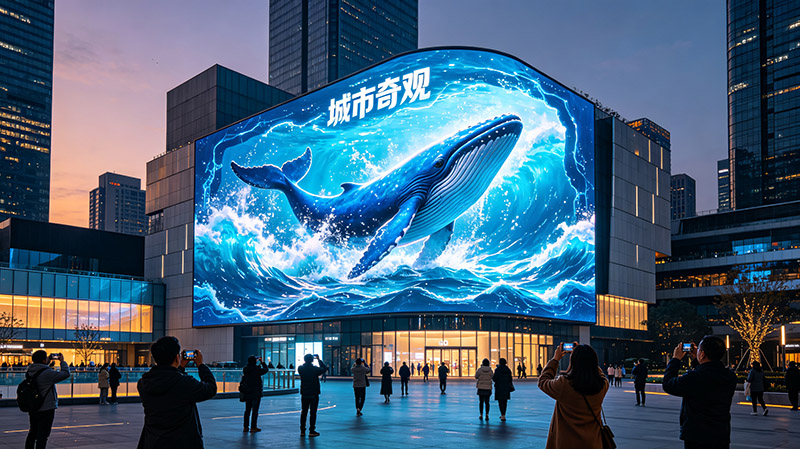
2.Social-media-dissemination capability: Creative content inspires users to shoot short-videos for social-media-sharing. Both on-site viewing experience and mobile-phone shooting performance shall be considered, with separate statistics for online and offline dissemination-metrics.
3.Strong visual impact: Depth-immersive imagery rapidly captures attention within complex urban surroundings.
4.Forge avant-garde brand-image: Cutting-edge display-technology reinforces brand-innovation recall and improves user-favourability.
5.Flexible content-customization: Support for remote-updates and scheduled rotating-playback. Source-materials must match screen-dimensions, resolution and viewing-points to guarantee stereoscopic-effect delivery.
|
|
V. Industry Development History & Typical Cases
Milestone Development Events
1.2017: Coca-Cola mechanical 3D billboard at New York Times Square. It achieves stereoscopic effects via numerous movable LED cubes, covering an area of 210.22 ㎡ and holding a Guinness-World-Records certification.
2.2020s: Rise of distortion-perspective LED billboards. Leveraging image-perspective-algorithms without mechanical moving-parts, naked-eye-3D can be realized on flat, corner-shaped and curved screens.
3.2023: Sphere venue in Las-Vegas. Exterior LED area totals 580 000 sq-ft; interior media-screens cover 160 000 sq-ft with 16K-image-output support.
Representative Projects
1.MSG Sphere (Las-Vegas): Curved large-format screen. Spherical geometric-projection-algorithms map 16K-footage onto the spherical display surface.
2.Yonge-Dundas Square (Toronto): Multi-directional pedestrian-flows and variable viewing-distances. Core project-workflow involves locking optimal viewing-zones and tuning screens, perspective-source-materials, brightness and video-duration.
VI. Cost Composition for Domestic Projects
Primary Cost-influencing Factors
1.Pixel-pitch and pixel-density: Smaller pixel-pitch raises costs; select rationally balancing viewing-distance and budget.
2.Screen-area and total-pixel-count: Determines quantities of modules, power-supplies and steel-structures plus labour-requirements. Total-pixel-count also impacts rendering-server load.
3.Screen-profile: Costs remain controllable for ordinary flat and right-angle screens. Custom-bevel, special-form-curved cabinets and non-standard steel-structures push up overall expenditure.
4.3D-content-production (independent expense): Screen-parameters, primary viewing-points, video-duration, format, copyright-terms and revision-counts must be clarified.
5.Site-conditions: Building load-bearing capacity, wind-load, hoisting-conditions, power-distribution, network-connectivity, administrative-approval-procedures and maintenance-access space. On-site surveys must be completed before formal quotation-issuance.
Additional Full-Lifecycle Expenses
Steel-structure-works, hoisting & cabling, full-unit calibration & commissioning, personnel-training; later-stage spare-parts, inspection & cleaning, software-licensing and ongoing-content-updates.
|
|
VII. Practical Planning Guidelines for Domestic Commercial-District Projects
1.Sino-Ocean Taikoo-Li (Chengdu, high-density pedestrian-traffic): Configure peak-stereoscopic-effects along natural pedestrian-directions. Guarantee legible brand-information from non-optimal viewing-angles. Execute source-material-testing under day-and-night brightness-conditions.
2.Wangfujing (Beijing, multi-range viewing-distances): Conduct on-site surveys of pedestrian-routes, reserve distinct core-viewing-zones, and ensure stereoscopic-effects are rapidly recognizable amid dense advertising-surroundings.
3.Nanjing Road (Shanghai, fast-moving pedestrian-traffic): Simplify introductory video-segments and focus on a single dominant stereoscopic-effect. Keep logos distinct, balancing on-site-viewing and short-video-shooting-performance.
4.Hangzhou landmark-projects: Integrate local-culture and seasonal-creative concepts. Ensure content is comprehensible even in looping-playback segments. Place vital text-elements away from heavy-distortion zones and prepare 2D backup-versions.
5.Zhujiang New-Town Facade-Projects (Guangzhou): Match screens to curtain-wall-grids, corner-radii, drainage-systems and maintenance-doors. Hardware-teams and content-teams shall share one unified structural-dimension-model.
VIII. Acquisition & Production of 3D Source-Materials
1.Commercial-model-libraries: Licensed model-libraries boost efficiency. Commercial copyright-compliance must be confirmed. Library-assets serve only as foundations and shall not be directly exported as finished-footage.
2.AI-assisted generation: AI can generate scripts and conceptual proposals. Artists shall subsequently verify models, textures, copyright-compliance and image-stability.
3.Professional production-software: Blender, Maya, C4D for modelling, animation, rendering and audio-synchronization.
4.Outsourced-production-delivery-specifications: Supply vendors with physical screen-dimensions, corner-curved-surface-structures, primary-camera-view-points, safe-zones, frame-rates-encoding and hardware-performance-constraints. Deliver test-frames and sample-clips before full-scale-rendering.
|
|
IX. Future Technical Development Trends
1.AI-enabled connected-operation & maintenance: Interface with weather, traffic and other datasets for context-aware playback. AI-assisted playlist-scheduling, fault-detection and creative-generation. All publicly-played content requires human-review-and-approval.
2.Divergence of two 3D-technical-routes: Lenticular naked-eye-stereoscopic screens are constrained by narrow-viewing-windows. Distortion-perspective billboards gain dominance for outdoor applications thanks to universal-compatibility.
3.Flexible & transparent special-form-LED: Modular cabinets combined with steel-structures realize diverse special-form-profiles. Transparent-LED suffers from contrast-ratio limitations and delivers sub-optimal 3D-performance.
4.Centralized multi-screen-operation-and-maintenance: Remote-platform-based multi-screen-management. Emphasis on offline-playback-capability upon network-loss and individually-replaceable modules to cut maintenance-costs.
5.Refined energy-consumption-management: Calculate power-draw based on actual configurations instead of relying purely on marketing-stated energy-saving-ratios. Modular replaceable-components extend overall unit-service-life.
X. Development Opportunities & Existing Challenges
Development Opportunities
1.Mature outdoor-cabinet-hardware: High-brightness, high-refresh-rate with customizable corners. M-series, MA-series, ME-series, AF-series, AT-series cabinets achieve IP65-protection and minimum 3840 Hz refresh-rate.
2.Dual-compatible-content: One hardware-set can toggle between creative-3D-content and ordinary 2D-advertising-and-information.
3.Modular-expandability: Free-combination of flat, right-angle and curved-modules. Require unified structural-models, pixel-mapping and installation-tolerance-control.
Existing Implementation-Challenges
1.High overall comprehensive-cost: Hardware constitutes only one component; budgets shall also cover steel-structures, engineering-works, content-production and later-stage-O&M.
2.Viewing-zone-limitations: Distortion-perspective-3D peak-effects occur only at preset-view-points; stereoscopic-perception degrades away from these positions. Heat-dissipation, sealing-performance and maintenance-access-corridors constrain project-realization.
3.Power-consumption and compliance-approval-procedures: Pre-calculate power-usage. Complete architectural, electrical and advertising-related administrative-approvals prior to construction.
XI. Frequently Asked Questions
1.What is the optimal viewing-angle for naked-eye-3D displays?
2.Which manufacturers produce 3D-LED billboards?
3.What hardware-and-software are required for producing 3D-content?
4.How to resolve ghosting-and-glare-issues for 3D-content?
5.Do 3D-LED displays demand higher brightness compared with ordinary screens?
XII. Summary
Successful 3D-LED projects require mutual matching among screen-hardware-parameters, cabinet-profiles, viewing-points, 3D-source-materials, steel-structures and operation-&-maintenance-schemes. For component-selection reference: M-series, MA-series, ME-series, AF-series and AT-series outdoor-advertising cabinets.
If you intend to launch a project, please provide installation-dimensions, viewing-distances, operating-environment, target pixel-pitch and project-timeline to obtain customized solutions and quotations.
Rental LED solution for stages and performances — curve-lock cabinets with fast rig, front...

Rental LED solution for large outdoor events and festivals — weather-ready, fast-lock cabi...

Rental LED solution for exhibitions and trade shows — fast-rig, seamless booth screens tha...
Send the pitch, size and site conditions — you’ll get a spec and a price, not a brochure.

